
Environmental management fabrics in Quebec
Our team will advise you on the right material for your application, durability and dimensions. Several materials are available to order, depending on your needs.
Fabrics designed for your environmental remediation projects: contaminated soil, runoff, containment and more

Other products
- Spill containment basin for equipment
- Ballast bag
As specialists in the environment, soil and water treatment, we can support you in your environmental rehabilitation projects.
Whether you need to cover exavated contaminated soils or biopiles during treatment, protect your workspaces in water, minimize sediment movement or protect the soil and environment from contaminants, we have a solution for you.
Contact our team for a solution tailored to your environmental project
Our team will advise you on which material to select based on your use, durability and required dimensions.
Megatex’s expert advice and seamless service will save you time and money.


M1080 polyethylene
High-density polyethylene 12 mil
Idéal pour: Covering debris and contaminated soil, as well as for ballast bags
Sold in 12' rolls

Poly6BB geomembrane
6 mil reinforced laminated extruded polyethylene geomembrane
Idéal pour: Containment of contaminated soil, for temporary covering or during bioventing treatment
Sold by the yard in 40' and 60' widths, or in 40' × 120' rolls
Poly8BB Geomembrane
Extruded polyethylene geomembrane, laminated with 8 mil reinforcement
Idéal pour: Containment of contaminated soil, for temporary covering or during bioventing treatment
FAQ about fabrics and environmental solutions
This FAQ answers frequently asked questions about tarpaulins, nets and geomembranes used for environmental management: covering biopiles, invasive plant control and soil protection. It is aimed at municipalities, site managers and environmental professionals looking for effective, standards-compliant solutions.
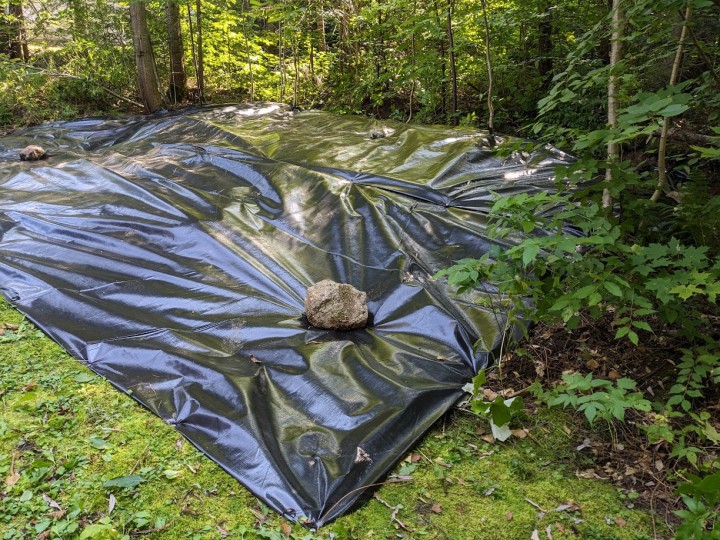
Tarping is a method frequently used to control or eliminate certain invasive exotic plants. In general, the
tarpaulin should remain in place for 2 years, but it can be up to 5 years, depending on :
- Invasive species (the most resistant, such as common reed or Japanese knotweed, require a longer cover)
- Site conditions (sunshine, humidity, colony vigour)
For maximum efficiency:
- The tarpaulin must be totally opaque, extend well beyond the colony, and be securely fastened and sealed to prevent light penetration.
- It is advisable to check regularly that no stems are piercing and that the edges remain sealed.
- The more vigorous the plant, the longer the duration.
Megatex polyethylene fabrics M1080 and M2000 are designed for this type of application, as they completely block light and are weather-resistant over long periods.
Both types of tarpaulin can be used to control vegetation, but their operation and effectiveness differ greatly.
Black tarpaulin, the most effective way to eliminate invasive plants
The black tarpaulin works by concealment:
- It blocks light, preventing photosynthesis.
- In the sun, it generates high heat under the tarpaulin, accelerating decomposition.
- This is the preferred method for highly resistant invasive alien plants.
Advantages :
- High efficiency for medium/long-term elimination
- Ideal for Japanese knotweed, phragmites, buckthorn, etc.
- Reliable results when the tarpaulin is thick and truly opaque
Suitable Megatex products :
- Polyethylene M1080 and M2000 – high-density, tough and waterproof
Transparent tarpaulin, faster but less reliable
The transparent tarpaulin is used for solarization:
- It lets in light, which raises the soil temperature.
- It can kill seeds and small weeds in intense heat, but is often ineffective against deep-rooted or rhizomatous invasive plants.
Several techniques exist, but opaque sheeting remains the most effective and long-lasting method of controlling invasive plants without chemicals.
Other possible approaches :
- Repeated cutting: slows growth, but does not eliminate the plant.
- Manual or mechanical uprooting: useful for small colonies, but rarely sufficient for rhizome species and requires a colossal amount of work.
For vigorous invasive plants, the most reliable solution is complete concealment with a hard-wearing opaque tarpaulin, such as the M1080 and M2000 geomembranes used in environmental applications.
Temporary cofferdams are designed to create a watertight barrier for the duration of a worksite in an aquatic environment. At Mégatex, they are
manufactured from flexible, welded PVC or Poly6BB geomembrane membranes, two materials that ensure the impermeability of the
structure.
High-frequency PVC welding technology produces perfectly watertight joints, capable of withstanding water pressure for the duration of the project.
These flexible cofferdams are then custom-assembled to the dimensions of the project, making them easy to install, move and
remove once the work is complete.
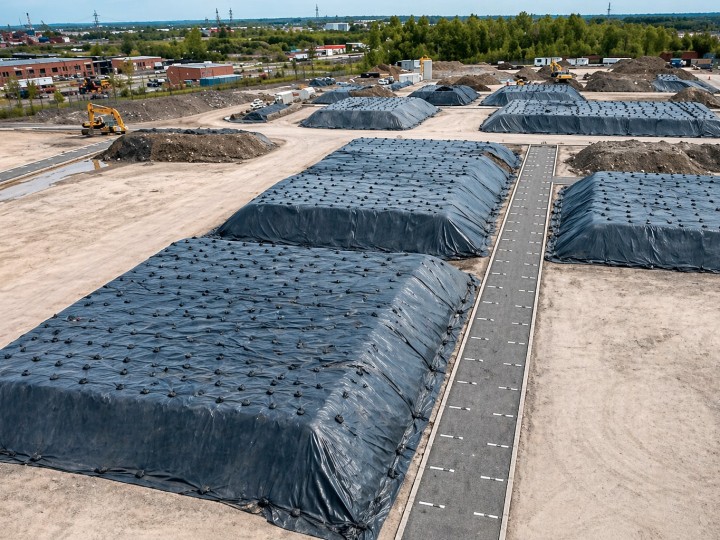
For projects involving the capping of contaminated soil piles, e.g. during excavation of contaminated soils or during treatment
by bio-ventilation, we mainly use :
Poly6BB geomembrane (reinforced extruded polyethylene)
It’s the ideal material for small and medium-sized batteries.
- High tightness to limit contaminant migration
- Integrated reinforcement reduces the risk of aggravating tears
- Durability in outdoor conditions
- Lightweight, easy to move during installation and removal
It is, however, less durable than the M1080
Polyethylene M1080
This material is ideal for all battery formats. It is more resistant in the medium to long term, but it is heavier, which
makes frequent handling more complex.
Our installation team can help your teams use the right methods and ensure efficient installation, reducing the human effort
required for toiling the largest stacks. Please contact us for more information.